
The guillotine stands as one of the most recognisable and controversial inventions in European history, closely tied to the French Revolution and the dramatic transformation of justice systems in the late 18th century. It was introduced as a method of execution intended to be fast, uniform, and less dependent on social class. Over time, it became a powerful symbol of revolutionary change, reflecting both the ideals of equality and the realities of political violence.
Interest in the guillotine continues today because it represents a turning point in how societies viewed punishment, law, and human rights. It is frequently studied in history, politics, and cultural discussions due to its dual identity as both a reformist invention and a feared execution tool. Understanding the guillotine provides insight into how revolutionary ideas can reshape institutions while also creating unintended consequences.
Guillotine: Meaning and Definition
The guillotine is a mechanical device designed for execution by beheading using a heavy, angled blade dropped from a height. Its primary purpose was to create a standardised and efficient method of capital punishment that eliminated the brutality and unpredictability of earlier execution techniques. The meaning of the guillotine is closely connected to ideas of equality before the law during revolutionary France.
In modern usage, the term guillotine extends beyond its historical function and is often used in educational or symbolic contexts. While it no longer serves as a method of execution, it remains an important historical reference point. The word is now associated with discussions of justice, political reform, and the evolution of legal systems in Europe and beyond.
Guillotine: Invention and Origins
The guillotine was developed during the late 18th century in France as part of a broader effort to reform capital punishment. At the time, executions varied greatly depending on social class, with nobility often receiving less brutal treatment than common citizens. Reformers sought a single, equal method of execution that would apply to all individuals regardless of status.
Although named after Joseph-Ignace Guillotin, the device itself was engineered with the help of medical professionals and craftsmen who refined its mechanical structure. The invention reflected Enlightenment ideals of reason, equality, and efficiency. Its creation marked a shift toward more systematic approaches to justice, even though its later use became deeply controversial.
Guillotine: History During the French Revolution
The guillotine became widely used during the French Revolution, particularly during the period known as the Reign of Terror. During this time, thousands of individuals were executed as revolutionary leaders sought to eliminate perceived enemies of the state. The guillotine became the primary instrument of execution, symbolising both revolutionary justice and political fear.
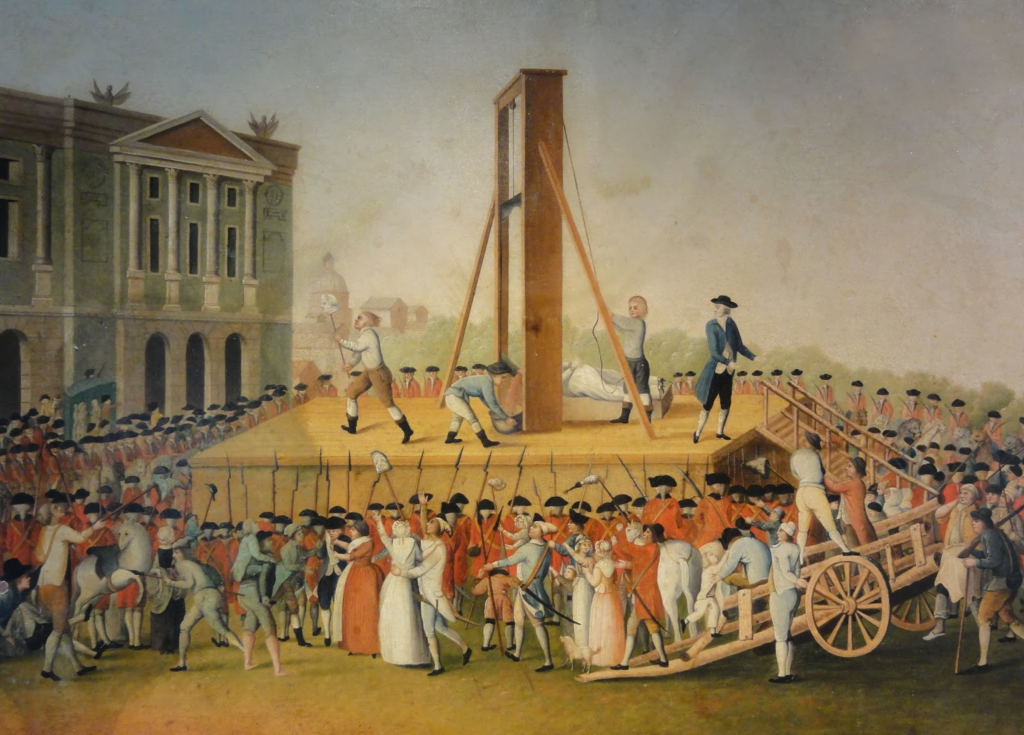
Public executions using the guillotine were often carried out in city squares, making them highly visible events. This visibility reinforced the authority of the revolutionary government while also instilling fear among the population. The device was used on individuals from all social classes, including aristocrats, politicians, and ordinary citizens, reflecting the revolutionary ideal of equality before punishment.
Guillotine: How It Worked and Design Structure
The guillotine operated through a relatively simple but highly effective mechanical system. It consisted of a tall wooden frame, a weighted blade, and a release mechanism. Once activated, the blade would drop rapidly under gravity, ensuring a swift and precise execution. The design was intended to reduce suffering and eliminate the inconsistencies of older methods.
Its engineering was based on efficiency and repeatability. The angled blade helped ensure a clean cut, while the positioning system held the individual securely in place. This mechanical precision made the guillotine one of the most efficient execution devices of its time, reflecting the industrial and scientific thinking that influenced its development.
Guillotine: Symbolism and Cultural Impact
The guillotine quickly became a powerful symbol of the French Revolution, representing both equality and terror depending on perspective. For supporters of the revolution, it demonstrated that justice applied equally to all citizens. For opponents, it symbolised fear, violence, and political repression during one of the most unstable periods in French history.
Over time, the guillotine has appeared in literature, films, and academic discussions as a representation of revolutionary extremes. It continues to serve as a reminder of how political systems can shift rapidly during times of upheaval. Its cultural impact extends far beyond France, influencing global discussions about justice and punishment.
Guillotine: Decline and Abolition
As societal attitudes toward capital punishment evolved, the use of the guillotine gradually declined. Growing awareness of human rights and ethical concerns about state execution led many countries to reconsider such practices. Although France continued to use the guillotine for many years, pressure for reform eventually increased.
The abolition of the guillotine marked a significant moment in modern legal history. It reflected a broader global movement toward more humane justice systems and the eventual rejection of execution as a standard punishment in many regions. Its removal symbolised the end of an era defined by revolutionary justice and public executions.
Guillotine in Modern Context
Today, the guillotine is no longer used as a method of execution and exists primarily as a historical artefact. It is studied in museums, history books, and educational programmes that focus on the French Revolution and the evolution of justice systems. Its legacy continues to attract academic interest due to its symbolic and historical importance.
In modern language, the term guillotine is also used to describe paper-cutting tools found in offices and craft environments. This secondary meaning contrasts sharply with its historical origins but demonstrates how language evolves over time. Despite this shift, the historical guillotine remains a powerful reminder of France’s revolutionary past.
Conclusion
The guillotine occupies a unique place in history as both a reformist invention and a symbol of revolutionary justice. It was designed to bring equality to capital punishment, yet it became deeply associated with fear and political violence during the French Revolution. Its story reflects the complexity of societal change during times of upheaval.
Although it has long been abolished, the guillotine continues to influence historical understanding and cultural discussions. It remains a symbol of how ideas of justice, equality, and power can evolve dramatically over time. Studying it provides valuable insight into the challenges and consequences of revolutionary change.
FAQs
What was the purpose of the guillotine?
The guillotine was designed to provide a fast, standardised, and equal method of execution during the French Revolution.
Who invented the guillotine?
It was named after Joseph-Ignace Guillotin, though engineers and medical experts contributed to its final design.
Why was the guillotine used in France?
It was used to replace more brutal execution methods and promote equality before the law.
When was the guillotine abolished?
It was officially abolished in France in 1981, marking the end of its use in capital punishment.
Is the guillotine still used anywhere?
No, it is no longer used anywhere in the world for execution and remains a historical device only.
What does the guillotine symbolise today?
It symbolises revolutionary justice, equality, and the darker side of political change in history.
You May Also Read: Sea Bass